How to Spot a Copycat Brand & 5 Key Ways to Protect Your Brand

TL;DR: Copycat Brands in 2025
What they are: Copycat brands imitate your products, packaging, or identity to profit from your reputation without innovating. Classic cases like the Jif Lemon test show when imitation crosses into passing-off.
Why they’re dangerous: They erode trust, confuse consumers, and drain sales. Courts in disputes like Red Bull v Big Horn confirmed that even without confusion, unfair advantage can still harm brand reputation.
AI makes it worse: The FTC’s Impersonation Rule bans AI deepfake endorsements, while its final rule on fake reviews cracks down on bogus testimonials.
Marketplaces respond: Amazon Project Zero and TikTok IP Protection Center let brands directly remove counterfeits, while the EU Digital Services Act enforces stricter takedown obligations across Europe.
Global guidance: WIPO highlights new IP risks from generative AI, stressing stronger monitoring and enforcement.
How to respond:
Audit and document infringements.
Protect IP with trademarks and takedown tools.
Differentiate on quality and customer trust.
Confront or escalate legally if needed.
Keep innovating so copycats can’t keep up.
One-click solution: Bustem automates scanning, evidence gathering, and DMCA/takedown submissions, helping brands fight copycats efficiently.
Every business wants to establish a reputation for quality and reliability, but what happens when a copycat brand tarnishes your identity? Let’s say you sell high-end skateboard gear, and a few months into your operation, you find a social media page featuring your products. Still, they're being marketed by a copycat brand with an almost identical logo and name. Instead of appealing to skateboard enthusiasts looking for premium equipment, this brand caters to bargain hunters looking for a cheap alternative. The scenario is alarming and all too common. The good news is that, in this article, we’ll help you confidently identify copycat brands and implement effective brand protection strategies to protect your business, brand identity, and market position.
Detecting copycat brands early on is key to mitigating their damage. Bustem’s copycat detection tool helps brands like yours quickly identify these imposters so you can take action.
Table of Contents
What is a Copycat Brand and Why They're Dangerous
A copycat brand imitates another business’ products, services, or overall identity. Copycat brands replicate an existing company’s strategy to capitalize on its hard-earned reputation without investing in original ideas or innovation. For example, Starbucks didn’t invent coffee shops when it entered the market. It just improved on a well-known concept.
Copycat brands are a reality of business today, especially in technology. When rival companies release new gadgets, consumers expect to see similar products. Copycat brands also exist in every industry. They can work and be hugely profitable but harm original brands and consumers.
The Dangers of Copycat Brands
The success of copycat brands comes at a cost to original brands and consumers. Copycat brands can undermine trust in a business’s products and services. Consumers expect the same quality as the original when they buy products from a lookalike brand. If they’re disappointed, it can hurt the reputation of the real brand not the copycat. Copycats also dilute market value. Taking sales from the original brand negatively impacts the company’s profitability and market share. This can result in lower stock prices and reduced investor confidence. Copycat brands also pose a risk to consumers. Similar products can confuse buyers.
This can lead to dangerous situations. For example, if a copycat brand produces a lookalike of a popular electronic device, the imitation may not meet safety standards or function pr, puttingan put consumers at risk. Beyond all of this, copycat brands often operate unlawfully. In many cases, they infringe on existing trademarks. When this happens, businesses must divert resources to protect their intellectual property instead of focusing on innovation.
AI-Driven Copycats & Platform Enforcement (2025 Update)
Generative AI and social commerce have changed how copycats operate and how platforms/policymakers respond. The resources below double as your playbook and give Google fresh, authoritative signals.
Deepfake endorsements & impersonation scams are up. The FTC’s consumer alert on fake celebrity ads explains how doctored video/audio is used to sell products, and the FTC’s Impersonation Rule (effective April 2024) gives the agency more tools against government/business impersonation scams. (Consumer Advice)
Fake reviews (often AI-generated) face stricter enforcement. The FTC’s final rule on fake reviews (Aug 2024) targets the sale/purchase of bogus testimonials—relevant when copycats inflate credibility with fabricated social proof. (Federal Trade Commission)
Marketplaces are expanding brand-protection tools.
Amazon: Project Zero lets verified brands instantly remove counterfeit listings—useful when copycats mirror your packaging or trademarks. (Sell on Amazon)
TikTok Shop: The IP Protection Center (IPPC) and its official user manual (PDF) walk rights-holders through takedowns; policy pages explicitly prohibit counterfeit sales. (ippc.tiktokglobalshop.com)
Regulators are raising the floor for platform accountability. The EU’s Digital Services Act tightens duties on marketplaces to tackle illegal goods and improve notice-and-action systems—relevant when lookalike listings appear across the EU. (European Commission)
Global IP bodies are updating AI guidance. WIPO’s resources on AI & IP (e.g., Generative AI: Navigating Intellectual Property and its AI & IP hub) outline risk areas for brands and enforcement considerations as AI scales imitation. (WIPO)
The Story of Lookalike Brands: A History
Copycat brands have existed since people started trading and marking goods. One of the earliest cases was reported in 1617. In it, one of the judges referred to a case involving an “a clothier, [who] had gained a great reputation for the making of his cloth [and] he used to set his mark to his cloth, whereby it should be known to be his cloth and another clothier perceiving it, used the same mark to his ill-made cloth on purpose to deceive him, and it was resolved that the action did well lie.”
The world of branding has moved on, but at the heart of a passing-off case is deceit. That gives us the famous legal test from Perry v Truefitt: “A man is not to sell his own goods under the pretence that they are the goods of another man.” The appeal for the copycat or lookalike is the same as in the 17th century. Someone has built up a reputation for quality goods, why not take advantage of that by making a product that looks similar?
How Close Is Too Close?
A copycat brand is a brand that is intentionally similar to another. The similarity may be found in the product's shape, packaging or color. We are not talking about counterfeit or "fake" products. A copycat brand attempts to get as close to a well-known brand as possible without infringing the original owner's intellectual property rights. There are many famous examples.
Morning Star v Express Newspapers
Where a communist broadsheet complained that the proposed "Daily Star", which was said to be a "popular, lively, exciting" newspaper with nearly nude models, was guilty of passing off, this case is more famous for the judge's comment that "only a moron in a hurry would be misled".
Reckitt & Colman Products Ltd. v Borden Inc. (1990)
This was the "Jif Lemon" case, where the House of Lords set the test for passing off.
United Biscuits v Asda (1997)
A battle between Asda's "Puffin" chocolate biscuits and United Biscuits' "Penguin" biscuits. The issue was that the packaging was similar enough to mislead consumers. This was the first reference to "taking a conscious decision to live dangerously".
Irvine v Talksport Ltd (2003)
Where an apparent endorsement was akin to passing off. Specsavers v Asda (2010) where the living dangerously concept was considered in some detail.
What is Trade Mark Infringement and Passing Off?
Most cases involving “copycat” brands centre around two specific areas:
Confusion: where a similar or identical sign is used about similar or identical goods or services which will likely confuse the public.
Unfair advantage/detriment: where a similar or identical sign takes unfair advantage of, or is detrimental to, the distinctive character or reputation of the trade mark.
Similarity and Likelihood of Confusion
The public will likely be confused if they believe the trademark holder made the product by the “copycat” brand. That sounds straightforward enough, but how does the trade mark holder prove that? One piece of evidence is the distinctiveness of the trademark. Is it unique or unusual, like:
KODAK
Zappos
Apple
At the other end of the scale are descriptive marks describing the product. The more distinctive the mark, with a similar copycat, the more likely a consumer will be confused. If the mark or get-up is generic, establishing confusion will be more difficult.
In Thatchers Cider Company Limited v Aldi Stores Limited
This year, the High Court concluded that Aldi's “TAURUS CLOUDY CIDER LEMON” did not infringe Thatchers Cider Company Limited's trademark nor amount to passing off. The court found a low similarity between Aldi's and Thatchers' products. The court decided that “THATCHERS” was aurally and conceptually different from “TAURUS.”
Unfair Advantage or Detriment
The court may assess whether a “copycat” brand has taken unfair advantage of a trademark's distinctive character or reputation to benefit from and exploit its value. The “copycat” brand need not intend to take advantage of the trademark's reputation. Detriment can weaken the trademark's ability to signify the goods or services it uses because of the “copycat” brand. Detriment will be found if the economic behavior of the average consumer of the goods or services has changed or is seriously likely to change. These concepts are different but often come together. They are typically asserted where it is challenging to establish confusion.
Red Bull GmbH v Big Horn UK Ltd and others (2020)
The claimant made a well-known energy drink, “Red Bull,” its branding was two silhouetted bulls charging at each other in front of a circle. The defendant made an energy drink named “Big Horn,” the branding had two charging rams in front of a circle. The court found that while there was no confusion, the defendants took advantage of the Red Bull branding.
This year, in William Grant & Sons Irish Brands Limited v Lidl
The court considered if the re-design of Lidl's Hampstead gin get-up infringed William Grant & Sons trademark and amounted to passing off regarding its product, Hendrick's gin. The court decided viewing Lidl's re-design of Hampstead Gin's get-up as accidental or coincidental was difficult. William Grant & Sons had a reasonable prospect of successfully demonstrating that Lidl intended to benefit from the reputation and goodwill of their trademark.
Related Reading
What Makes a Brand Original? Authentic vs. Copycat Brand

Originality Is Key: The Elements of Authentic Brand Identity
Brand originality is about being authentic to your mission, vision, and values. An authentic brand communicates originality through:
Unique value proposition
Innovative products
A distinct voice in the marketplace
This helps build long-term consumer loyalty and brand equity. In contrast, copycat brands tend to follow rather than lead and, as a result, lack originality.
Focus: Authentic Brands Know Their Target Audience
One of the distinguishing features of copycat brands is their lack of focus. These brands are often complex, as they don’t know what they stand for or who they serve. They try to cater to everyone by offering various services and products to survive. Authentic brands know exactly what they stand for and who they serve, so they always focus on simplicity. They understand their clients and strive to make their customers’ lives easier.
Relationship With The Audience: Authentic Brands Connect With Their Customers
Copycat brands don’t have a defined target audience, so their messaging lacks empathy. Their messaging is very generic and tends to talk about features. Original brands close the communication loop by getting feedback, and they connect with their audience a lot easier because they understand their clients’ pain points and how to help them.
Structure: Authentic Brands Are Built On Emotional Connection
Copycat brands are built on a Unique Selling Proposition of service. These brands don’t understand the emotional drive behind their customers’ purchases, so they focus on unique features others may not offer. Even though it is smart to focus on features the marketplace needs to include, it is a short-term business model, as others will want to catch up. The competition will start copying these features, so they must repeatedly reinvent the wheel to sustain the business. Original brands are built on the Unique Buying State of the Customer. They understand that about 65% of purchasing decisions are based on emotions. They focus their message on the customer's emotional state before and after purchase to encourage purchase.
Extensibility: Authentic Brands Foster Customer Loyalty
Copycat brands have single-use offers. These brands should have taken the time to create a customer journey where the brand keeps re-inviting the client to engage with the brand. Having only single-use offers is risky because the brand has to chase new customers. It can depreciate the price of the service and doesn't allow room to create brand loyalty.
Authentic brands understand that their customers are in different stages in the sales cycle, so they structure their services to create trust and brand loyalty over time. They have minimal value offers much cheaper than their signature offers to help new prospects get a taste of the brand before investing a large chunk of money.
Picture In Client’s Mind: Authentic Brands Are Memorable
Brand loyalty is low since copycat brands don’t focus on the customer journey. People tend to forget about them because they look alike, sound alike, and act alike with Susie from the corner, who offers the same services. Authentic brands are memorable because they understand their clients’ struggles and feelings before the purchase, so they can focus on solving the problem instead of trying to sell someone something they don’t need.
All in all, taking the time to think about your brand from a customer’s perspective can help your brand grow quicker, last longer, be memorable, and stand out from the crowd.
Related Reading
5 Ways to Deal with Copycats in Business

1. Be Flattered, Then Conduct a Strategic IP Audit
When you discover someone copying your business, your initial reaction will likely be anger mixed with disbelief. You've invested years developing your concept, building your brand, and establishing market presence—and now someone's brazenly replicating it? While frustrating, this moment actually signals something important about your business trajectory.
Reframe the Situation
Take a step back and recognize what imitation really means: your business model, branding, or products are successful enough to warrant copying. As the saying goes, imitation is the sincerest form of flattery. If competitors are studying and replicating your approach, you've clearly established something valuable in the marketplace.
Conduct Your Legal Checklist
Before reaching for the phone to call an attorney, perform a systematic evaluation of the situation:
Trademark Assessment
Review all your registered trademarks and compare them against the copycat's use
Check if they're using identical or confusingly similar marks on similar goods or services
Document any instances where consumers might reasonably believe the copycat's products originate from your company
Consider whether there's potential for trademark infringement based on likelihood of confusion
Copyright Evaluation
Identify if they've copied your original creative works—photographs, written content, website design, marketing materials, or product packaging
Screenshot and archive evidence of copyright infringement with timestamps
Determine if the copying constitutes substantial similarity beyond mere inspiration
Trade Dress Analysis
Examine whether they've replicated the overall look and feel of your product or packaging
Assess if your trade dress is distinctive enough to warrant protection
Evaluate whether consumers could be confused by the visual similarity
Patent Considerations
If you hold utility or design patents, determine if the copycat's products infringe on your protected innovations
Consult patent claims to identify potential violations
When to Escalate
For minor infractions where there's clear infringement of your intellectual property, a well-crafted cease and desist letter often resolves the issue quickly and cost-effectively. Many copycats immediately back down when confronted with formal legal documentation. However, if the copying is extensive, intentional, and causing measurable business harm, consulting with an intellectual property attorney becomes essential to protect your market position and brand reputation.
2. Strategically Mark Your Territory with IP Protection
Building a defensible moat around your brand requires proactive intellectual property protection. The brands that successfully fend off copycats aren't those that react to infringement—they're the ones that anticipated it and built comprehensive protection systems before problems emerged.
Establish Your IP Foundation
Trademark Registration Register trademarks for your brand name, logo, taglines, and any distinctive product names. Federal trademark registration provides nationwide protection and serves as public notice of your ownership rights. Don't limit yourself to just your primary mark—consider registering variations and industry-specific applications of your brand.
Copyright Your Creative Assets While copyright protection exists automatically upon creation, formal registration with the U.S. Copyright Office provides significant advantages in enforcement, including statutory damages and attorney's fees in infringement cases. Prioritize registration for your most valuable creative assets—your website content, product photography, marketing videos, and proprietary training materials.
Document Everything Maintain detailed records of when you created assets, launched products, and entered markets. This documentation becomes crucial evidence if disputes arise about who was first to use certain elements.
Choose Your Battles Wisely
Not every instance of copying warrants aggressive legal action. Experienced brand owners develop judgment about which battles matter:
When to Fight
The copying directly impacts your revenue or market share
Customer confusion is occurring or likely to occur
The infringer is operating in your core markets
Your brand protection requires you to enforce consistently to maintain strong rights
The copycat is using your registered trademarks or copyrighted materials
When to Monitor but Not Engage
The similarity is superficial and unlikely to cause confusion
The copycat operates in a completely different market or geography
The cost of enforcement would exceed the business impact
The copying involves unprotectable elements like general ideas or industry-standard practices
Leverage Modern Enforcement Tools
Today's brand protection landscape offers automated solutions that didn't exist a decade ago. Platforms like Amazon's Brand Registry now provide enhanced controls for trademark owners, making it easier to identify and remove counterfeit listings. Similarly, AI-powered monitoring services can scan millions of websites and social media platforms to detect unauthorized use of your content, images, and trademarks.
When infringement occurs, swift action matters. DMCA takedown services streamline the process of removing infringing content from websites, marketplaces, and social platforms, often resolving issues within days rather than months.
3. Differentiate Through Strategic Positioning and Customer Focus
Jeff Bezos famously advised, "If we can keep our competitors focused on us while we stay focused on the customer, ultimately we'll turn out all right." This wisdom becomes particularly relevant when dealing with copycats. The moment you spend more time obsessing over imitators than serving your customers is the moment your competitive advantage begins eroding.
The Differentiation Imperative
Research from Harvard Business School consistently demonstrates that sustainable competitive advantage comes from differentiation—offering customers something uniquely valuable that competitors cannot easily replicate. However, as strategy research reveals, true differentiation extends far beyond product features. It encompasses your entire customer experience, from initial awareness through post-purchase support and beyond.
Focus on What Copycats Can't Duplicate
While copycats can imitate your products, packaging, or even your marketing language, they cannot easily replicate several critical elements:
Your Customer Relationships The trust and loyalty you've built with customers over years of consistent delivery creates a moat that superficial copying cannot breach. Customers who've had positive experiences with your brand are unlikely to switch to an unknown imitator, even at a lower price point.
Your Organizational Culture and Expertise Your team's accumulated knowledge, problem-solving approaches, and customer service philosophy represent institutional capabilities that take years to develop. A copycat might clone your product catalog but cannot clone your organizational DNA.
Your Brand Story and Values Authentic brands that stand for something beyond profit create emotional connections that imitators lack. Customers increasingly choose brands whose values align with their own, and this alignment cannot be faked or copied.
Your Innovation Pipeline While copycats are busy replicating your current offerings, you should already be developing the next generation. Companies that maintain a robust innovation cycle stay perpetually ahead of imitators.
Build Systematic Customer-Centricity
Rather than implementing knee-jerk reactions to every copycat move, successful brands maintain unwavering focus on customer needs and experiences. This customer-centric approach manifests in several ways:
Deep Customer Understanding Invest in understanding your customers' pain points, motivations, and desired outcomes at a granular level. This understanding enables you to create solutions that resonate emotionally, not just functionally.
Superior Service Delivery Excellence in execution creates differentiation that product features alone cannot achieve. When customers know they'll receive exceptional service, responsive support, and reliable solutions, they become far less price-sensitive and loyalty increases dramatically.
Continuous Value Creation Don't rest on past successes. Regularly introduce new features, services, or experiences that add value for customers. This positions your brand as the innovator and market leader, while copycats remain perpetually reactive and behind the curve.
The Competitive Psychology Advantage
There's a psychological dimension worth considering: copycats focused on you are not focused on themselves. While they're reverse-engineering your products and mimicking your marketing, they're neglecting their own strategic development, customer insights, and innovation opportunities. This reactive posture almost always leads to mediocrity, not market leadership.
As noted in competitive strategy research, brands on the path to copying others rarely achieve extraordinary results. They're building businesses designed to be "good enough" rather than exceptional, and that fundamental limitation becomes increasingly apparent to customers over time.
4. Directly Challenge Copycat Behavior with Professional Confrontation
Addressing copycat situations doesn't require choosing between passive acceptance and aggressive litigation. A middle path—professional, direct confrontation—often proves most effective and maintains your options for escalation if needed.
The Value of Direct Communication
Before involving attorneys or filing formal complaints, consider reaching out directly to the individual or company copying you. This approach offers several advantages:
Understanding Motivations You might discover the copying was unintentional, resulted from hiring your former employees, or stems from misconceptions about industry standards. Understanding the "why" behind the behavior informs your response strategy.
Faster Resolution Direct conversations often resolve disputes more quickly than legal proceedings. Many copycats, when confronted directly, will modify their approach to avoid potential legal complications.
Preserving Relationships In some industries, maintaining professional relationships matters for future partnerships, referrals, or collaboration. Direct communication allows you to address concerns while keeping doors open.
Gathering Intelligence Through conversation, you may learn about their business model, target customers, or strategic direction—information that helps you refine your own positioning and competitive differentiation.
How to Approach the Conversation
Be Professional, Not Personal Frame the discussion around business practices and market positioning, not personal attacks. Maintain a tone of professional inquiry rather than accusation.
Ask Questions First Begin with genuine curiosity: "I've noticed similarities between our offerings. I'm curious about your approach and how you're positioning yourself in the market?" This creates dialogue rather than defensiveness.
Clearly State Your Concerns Be specific about what elements concern you—whether it's similar branding, copied content, or confusingly similar product designs. Avoid vague accusations; provide concrete examples.
Explain the Business Impact Help them understand why the similarity creates problems—customer confusion, brand dilution, or market positioning challenges. Frame it as a mutual problem that affects industry credibility.
Offer Solutions Rather than just presenting problems, suggest potential resolutions. Perhaps they could modify their branding, adjust their messaging, or differentiate their positioning in ways that benefit both businesses.
When Direct Confrontation Works Best
This approach tends to succeed when:
The copycat is a smaller operation or individual entrepreneur who may not fully understand IP implications
There's no evidence of malicious intent or systematic brand jacking
The copying is relatively recent and hasn't become ingrained in their business model
You're willing to find mutually acceptable solutions rather than demanding complete cessation
Know When to Escalate
Direct communication isn't always appropriate. Skip this step and proceed directly to legal action when:
The copying appears intentional and strategic
They've ignored previous informal communications
The infringement involves your registered trademarks or copyrights
Customer confusion is already occurring
They're operating at significant scale or in direct competition for your core customers
Evidence suggests they've systematically copied multiple competitors
In these cases, a cease and desist letter from an attorney or formal DMCA takedown notice becomes necessary to demonstrate the seriousness of your position and create a legal record of your enforcement efforts.
Document Everything
Whether you choose direct conversation or immediate legal action, meticulously document all communications, evidence of copying, dates of discovery, and business impacts. This documentation becomes invaluable if the situation escalates to formal legal proceedings or if you need to demonstrate a pattern of enforcement to protect your trademark rights.
5. Innovate Relentlessly and Stay Beyond Reach
The ultimate defense against copycats isn't legal action or direct confrontation—it's maintaining such a rapid pace of innovation and excellence that imitators cannot keep up. Companies that win the long game aren't those that build the highest legal walls; they're those that continuously move the goalposts forward.
The Innovation Imperative in 2025
Today's business environment demands continuous evolution. According to recent business resilience research, organizations that prioritize innovation and adaptability are better positioned to weather market disruptions, changing customer preferences, and competitive pressures. This reality intensifies when copycats enter your market—standing still means allowing imitators to catch up and potentially surpass you.
Building an Innovation Culture
Embrace Emerging Technologies Stay current with technological advances in your industry. Whether it's AI, automation, new materials, or novel distribution channels, being first to effectively implement new capabilities creates temporary monopolies that generate significant returns before copycats can adapt.
Foster Creative Problem-Solving Build organizational cultures that encourage experimentation, tolerate intelligent failures, and reward creative thinking. Companies with strong innovation cultures consistently generate ideas that keep them ahead of reactive competitors.
Invest in Research and Development Allocate meaningful resources to R&D, even when business is good. The innovations you develop today become your competitive advantages tomorrow. Copycats, by definition, invest in replication rather than innovation, creating an inherent disadvantage they struggle to overcome.
Stay Close to Evolving Customer Needs Innovation shouldn't be technology for technology's sake. The most valuable innovations solve emerging customer problems or fulfill latent needs customers don't yet recognize. Maintain constant dialogue with your customer base to identify these opportunities before competitors do.
The Pace Advantage
When you maintain a rapid innovation cycle, copycats face an impossible challenge: by the time they've successfully replicated your current offering, you've already moved on to the next generation. This creates a permanent lag that becomes increasingly difficult to overcome.
Consider how successful technology companies operate: they announce next-generation products before competitors have caught up to their current generation. This strategy isn't just about maintaining market leadership—it's about making the act of copying less economically viable. Why would a copycat invest resources replicating a product that's about to become obsolete?
Quality as an Innovation Dimension
Innovation isn't limited to new products or features. Systematic improvements in quality, reliability, customer service, or operational efficiency represent innovations that create differentiation. These operational innovations often prove more defensible than product innovations because they're embedded in organizational capabilities rather than easily observed features.
If your product is copied but customers consistently experience superior quality, faster delivery, better support, or more reliable performance from you, the copycat's superficial similarity becomes irrelevant. Customers learn through experience that the imitation doesn't deliver the same value.
Transform Copying Into Motivation
Rather than viewing copycats as threats, reframe them as validation and motivation. Each time someone copies you, it confirms you're building something worth imitating. Use that validation as fuel to push even further ahead.
Many successful entrepreneurs report that being copied initially bothered them but ultimately drove them to higher levels of innovation and excellence. The presence of copycats forced them to articulate what made their offering truly distinctive, to identify which elements provided genuine competitive advantage, and to focus their innovation efforts on areas where they could establish the widest moats.
The Long-Term Perspective
Building a resilient business that remains competitive despite copycats requires thinking beyond quarterly results. Companies that make short-term decisions to match competitors often sacrifice their long-term positioning. Instead, maintain focus on your strategic vision and customer value proposition, even when imitators create short-term pressure.
Research on brand innovation strategy demonstrates that successful brands treat innovation as a deliberate choice, not a reaction to competitive threats. They build systematic processes for identifying opportunities, testing concepts, and bringing innovations to market—creating a sustainable engine for staying ahead.
Practical Innovation Tactics
Monitor Industry Trends Actively Don't wait for industry shifts to reach you. Actively scan for emerging trends, regulatory changes, technological breakthroughs, and evolving consumer behaviors. Position yourself to lead change rather than respond to it.
Build Strategic Partnerships Collaborate with complementary businesses, technology providers, or industry innovators to access capabilities you don't possess internally. These partnerships can accelerate your innovation cycles and create unique offerings copycats cannot easily replicate.
Protect Strategic Innovations While maintaining rapid innovation pace, don't neglect IP protection for your most significant breakthroughs. File patents for novel inventions, register trademarks for innovative branding, and use trade secret protection for proprietary processes. This creates legal barriers that complement your innovation-driven competitive advantages.
Create Customer Co-Innovation Involve your most engaged customers in your innovation process. Their insights, feedback, and co-creation participation generate solutions precisely calibrated to market needs while building powerful loyalty. Customers who helped shape your innovations become advocates who resist switching to imitations.
The Compound Effect
The beauty of the innovation strategy is its compound effect. Each innovation you introduce creates new standards in your market, educates customers about what's possible, and forces copycats to play catch-up. Over time, the cumulative gap between you and your imitators widens rather than narrows, even if they successfully copy individual elements.
This creates a virtuous cycle: your market leadership attracts the best talent, commanding premium pricing funds further innovation, customer loyalty provides direct feedback for improvements, and your brand reputation draws partnership opportunities—all advantages that copycats lack.
Find and Take Down Copycats with One-click Today
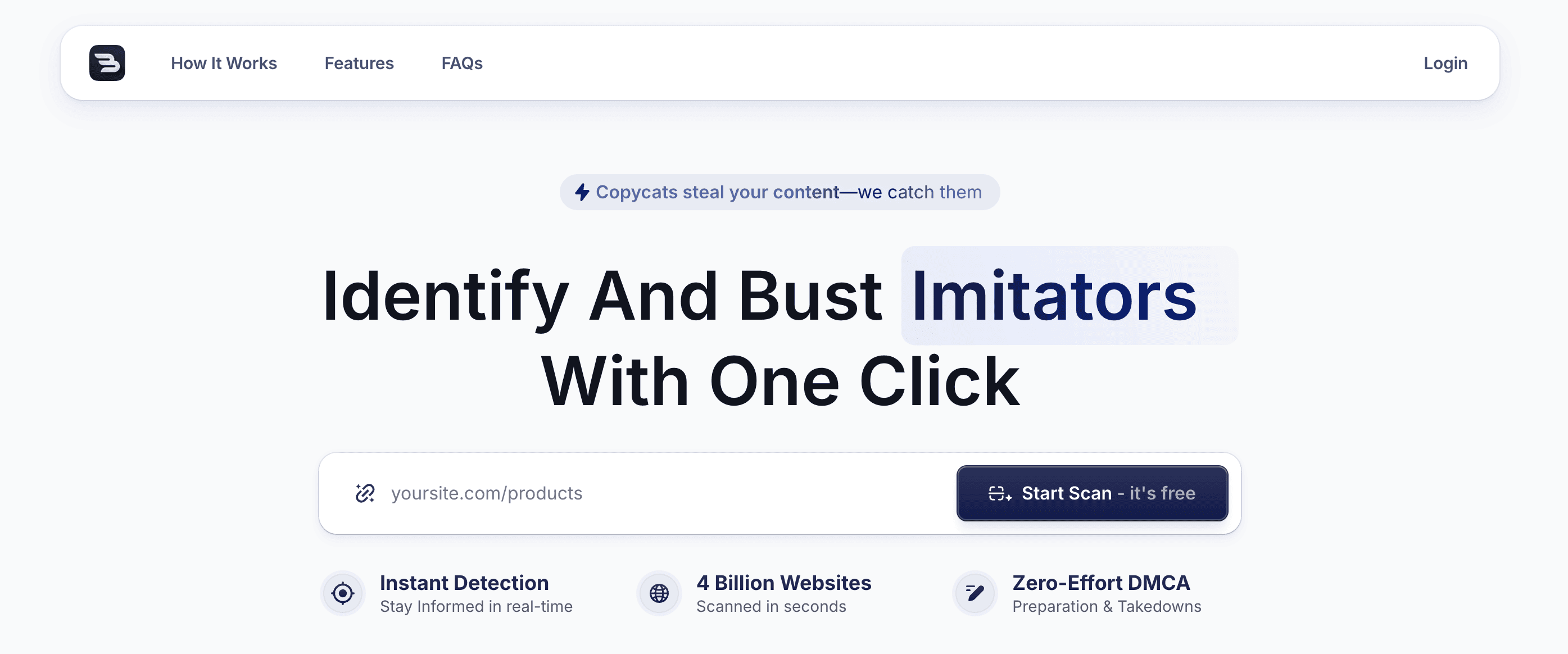
Bustem is a powerful copycat detection and removal tool for e-commerce merchants. Our platform automatically scans billions of websites to identify unauthorized use of your store content, including:
Images
Videos
Headlines
Text
Once we spot copycats, we streamline the entire takedown process with pre-filled DMCA forms and comprehensive case management.
Protect Your Brand with Bustem's Content Protection Service
Built by people who know the game inside out, our service offers 24/7 monitoring, instant detection, and bulk takedown capabilities to protect your brand assets. With over 2M DMCA notices filed daily and businesses losing $29B annually to content theft, we've made protection simple and cost-effective. Whether dealing with competitors using your product images, copying your ad content, or stealing your copy, Bustem helps you identify and eliminate copycats efficiently.
Get started with a free scan and see who's been stealing your content. Find and take down copycats with one click today with Bustem.
Related Reading
Updated on:
Written by
Oliver Brocato, Founder of Bustem
Oliver Brocato is the founder of Bustem. Before launching Bustem, he built, scaled, and exited an 8-figure e-commerce brand, where he experienced firsthand the pain of knockoffs, copycats, and counterfeits. Since then, Bustem has enforced takedowns on more than 100,000 listings, reclaimed over $1M in lost revenue, and protected the reputation of 120+ brands - from fast-growing startups to global enterprises.